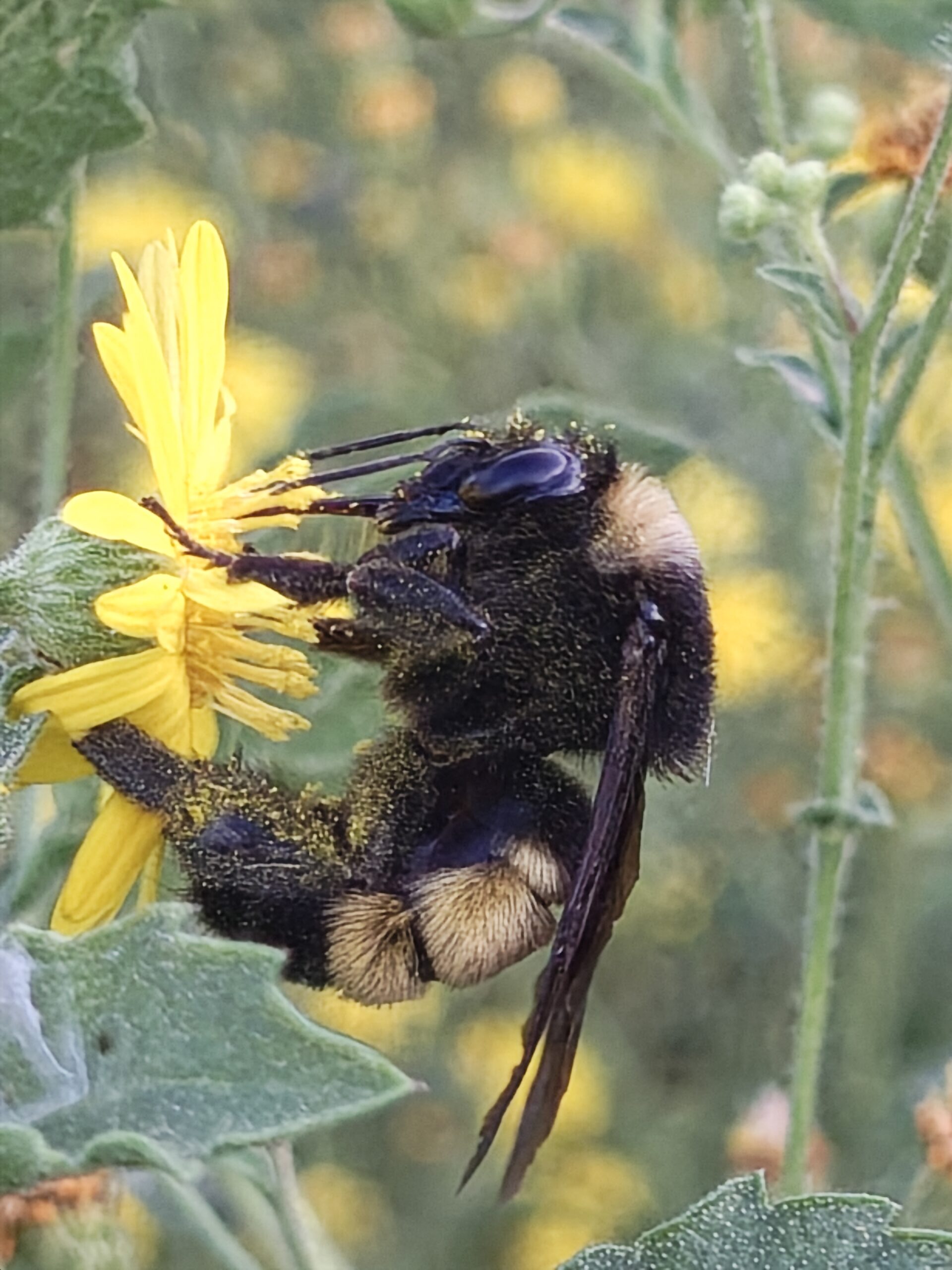
The flowers that little bumblebee (and the honey bees) is foraging from is a common Texas weed called camphorweed (Heterotheca subaxillaris). This hardy flowering wild plant is a perennial, aromatic herb up to 203 centimeters (80 inches or 6 2/3 feet) in height, often with several erect stems. The stems are hairy to bristly. The inflorescence contains 3-180 daisy-like flower heads in a flat-topped array. Each head contains 15–35; yellow ray florets surrounding 25–60 disc florets at the center.[1]
It likes sandy soil, so it thrives in prairies with high sand content. It is also drought-tolerant. On my farm, it is growing abundantly due to the little bit of rain we had a few weeks ago.
The leaf volatiles from which the name “camphorweed” is derived include camphor, but as a minor constituent (less than 2%); of 41 documented volatiles, for example, caryophyllene, pinene, borneol, myrcene, and limonene each comprised over 5% of the total.[2]
Camphorweed blooms from July through November, and it is a great Fall foraging source for bees as they get ready for Winter and stock up on honey and pollen for the colder months.
[1] Flora of North America, Heterotheca subaxillaris (Lamarck) Britton & Rusby, 1887.
[2] Lincoln, D.E., B.M. Lawrence. 1984. The volatile constituents of camphorweed, Heterotheca subaxillaris. Phytochemistry 23(4):933-934